 Back to all Member Galleries
Yares Art
479 Rodeo Drive
Beverly Hills, CA 90210
By Appointment
310 362 3464
Also at:
745 Fifth Avenue
New York, NY 10151
212 256 0969
1570 Pacheco Street, Suite A1
Santa Fe, NM 87505
Appointment Recommended
505 984 0044
Beverly Hills, CA 90210
By Appointment
310 362 3464
Also at:
745 Fifth Avenue
New York, NY 10151
212 256 0969
1570 Pacheco Street, Suite A1
Santa Fe, NM 87505
Appointment Recommended
505 984 0044
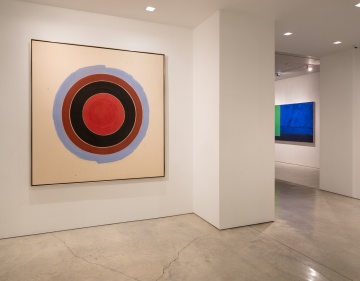
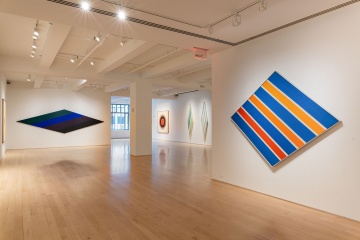
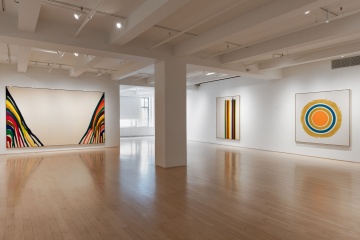
Yares Art was founded in 1964 by Riva Yares in Scottsdale, Arizona. In 1991 Yares Art established a second gallery in Santa Fe, NM. In 2016 the gallery opened its flagship venue in New York City. In 2019, Yares Art added 4000 square feet of exhibition space to its 5th Avenue NY location creating a combined 10000+ square feet of gallery space with six specific exhibition spaces. In 2023 Yares Art expanded to Beverly Hills, CA. The primary focus of the gallery over six decades is Abstract Expressionism paintings from the 1950s and 1960s, with a strong focus on the Color Field artists of that era.
Yares Art represents the estates of Thomas Downing, Friedel Dzubas, Joseph Marioni, Jules Olitski, and exclusively represents Larry Poons.
Yares Art publishes six catalogues and one book annually.
Yares Art has been a member of the ADAA for nearly 30 years and most recently participated in Art Basel, Art Basel Miami Beach, Art Basel Paris, The Art Show (ADAA), EXPO Chicago, TEFAF Maastricht, TEFAF New York.
Artists Represented:
Thomas Downing
Friedel Dzubas
Joseph Marioni
Jules Olitski
Larry Poons
Works Available By:
Arman
Milton Avery
Fletcher Benton
Ilya Bolotowsky
Byron Browne
Gene Davis
Thomas Downing
Friedel Dzubas
Helen Frankenthaler
Dorothy Fratt
Adolph Gottlieb
Hans Hofmann
Martin Horowitz
Penelope Krebs
Morris Louis
Howard Mehring
Joan Mitchell
Robert Motherwell
Manuel Neri
Kenneth Noland
Jules Olitski
Larry Poons
Rotraut
David Smith
Frank Stella
Esteban Vicente
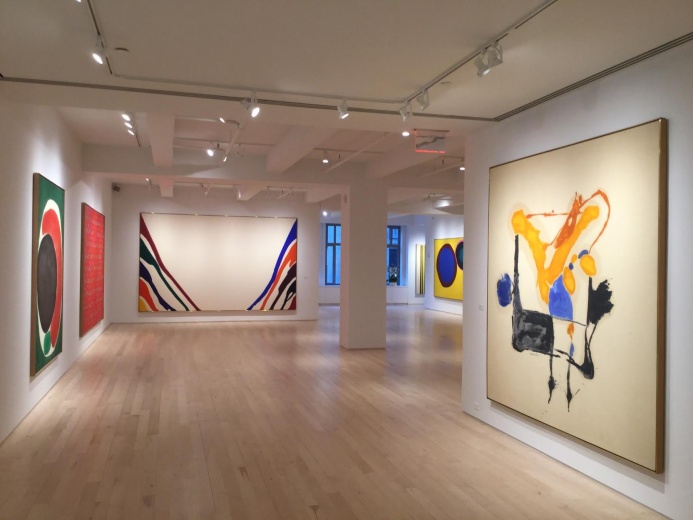
Installation view of Helen Frankenthaler + LMNOP. Courtesy of Yares Art, New York.
Helen Frankenthaler and Anthony Caro
Frankenthaler + Caro: Similitudes
April 11, 2026 - July 11, 2026
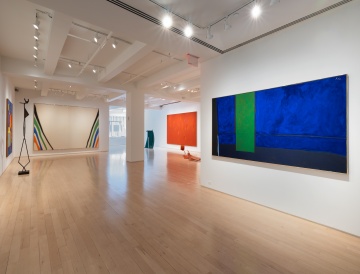
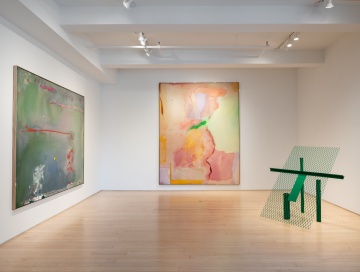
Yares Art is pleased to present SIMILITUDES: Color, Form, Friendship, an exhibition that foregrounds the compelling dialogue between American painter Helen Frankenthaler (1928 - 2011) and British sculptor Anthony Caro (1924 - 2013).
Acquainted for the first time in New York in 1959, Frankenthaler and Caro developed an enduring friendship centered on rigorous conversation and mutual respect. For the first time, this exhibition positions their relationship as an active site for creative and aesthetic exchange, bringing together carefully selected paintings and sculptures to illuminate their shared concerns and corresponding intuitions on color, form, surface, material and space.
At crucial moments in their early development, both artists received encouragement from critic Clement Greenberg, helping to orientate them towards a renewed understanding of abstraction as an open, spatial, and chromatic language. Archival letters, postcards, and photographs spanning over nearly five decades (detailing studio visits, artwork progress, and sustained conversations) further reveal the depth of their artistic exploration and exchange. In a 1972 letter Frankenthaler wrote to Caro: “The best part of your letter was the last sentence... How about that plan to make a sculpture together?!!!!!!”. At once playful and serious, Frankenthaler’s remark captures the permeability between their practices and the generative force at the heart of their friendship.
SIMILITUDES is organized with the generous support of the gallery’s major lenders, in collaboration with the Anthony Caro Centre and with the assistance of The Helen Frankenthaler Foundation. A fully illustrated catalogue featuring previously unseen archival material will accompany the exhibition, including an introduction by acclaimed art critic Michael Fried and a new essay by accomplished art historian and curator Karen Wilkin, a close friend of both artists.
Jules Olitski
Voyage into the Light
January 15, 2026 - February 28, 2026
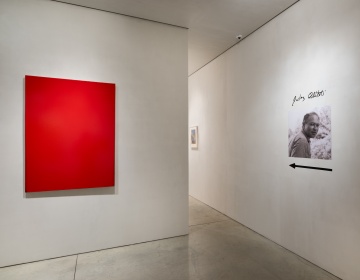
YARES ART is pleased to present Jules Olitski: Voyage into the Light, an exhibition of fifteen landscapes on paper dating from the artist’s final decade. An early pioneer of Color Field painting, Olitski turned toward landscape in the mid-1990s, dedicating his vast energies to depicting visionary scenes inspired by his waterfront studios in New Hampshire and Florida.
Jules Olitski’s art flowered in the final decade of his half century career, as he worked with equal intensity on abstract painting and sculpture, printmaking, life drawing, landscapes, and abstractions in watercolor, gouache, and pastel on paper. Art critic Michael Fried, writing about these landscapes, remarked: Olitski “seems to have worked not only with growing imaginative freedom but also with a kind of visionary intensity that belongs only to a select group of masters in the history of modern art.”
Stressing the continuity of his vision whether working in abstract or representational modes, Olitski depicts sailboats, plants, and figures in many of these works while others, like Night Legend (2002) and Night Arrives (2006), capture the dramatic atmosphere of the landscape through subtle contrasts of light and dark. Olitski, inspired throughout his career by the Old Masters, channels the landscapes of Eugene Delacroix and J. M. W. Turner in works containing an expansive range of moods, from the serene stillness of Sail in Evening Light (2005) to the tempestuous energy of Off Henry Key (1999). Sea and sky dissolve into one another in the lusciously colored Shimmering Cove (2001), while Olitski’s mastery of color is evident in the bold palettes of Estuary Light (2001) and Voyage in an Orange Light (2004).
Olitski’s works on paper have been the subject of exhibitions in galleries and museums across North America including the Butler Institute of American Art, Youngstown, OH; the Portland Museum of Art, Maine; and the Luther W. Brady Art Gallery in Washington, D.C.
Born in Snovsk, Soviet Russia, in 1922, Olitski and his family emigrated to the United States the following year and settled in Brooklyn. After studying art at the National Academy of Design, the Beaux-Arts Institute of Design, and the Académie de la Grande Chaumière, Olitski had his first solo exhibition in 1951 at Galerie Huit in Paris. In 1958, his first New York solo show was held at the Alexander Iolas Gallery. Olitski’s work has been exhibited in museums worldwide, including the Whitney Museum of American Art; Museum of Fine Art, Boston; Corcoran Gallery of Art; Hirshhorn Museum; Buffalo AKG Art Museum; Musée de Valence, France. In 1969, Olitski was the first living American artist to receive a solo exhibition at the Metropolitan Museum of Art in New York. His paintings are held in major museum collections including the Museum of Modern Art; the Solomon R. Guggenheim Museum; the National Gallery of Art, Washington, D.C.; the San Francisco Museum of Modern Art; and Tate Modern, London.
Fields of Color V
September 15, 2025 - March 31, 2026
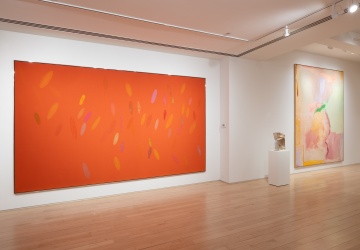
YARES ART is pleased to present Fields of Color V on view in our New York gallery from September 2025 to February 2026. Fields of Color V materializes the personal and professional relationships between the principal artists of the Color Field and Abstract Expressionist movements. The twenty-eight monumental scale works on view demonstrate the revolutionary techniques employed by these artists, often learned or influenced from one another, that went on to permanently alter the trajectory and status of American art in the canon of art history.
FIELDS OF COLOR V opens with Hans Hofmann’s Rising Moon (1965) hung next to Helen Frankanthaler’s Acres (1959). Hofmann, a career educator, served as a teacher to Frankenthaler in addition to artists such as Lee Krasner, Joan Mitchell, and Frank Stella who were enrolled at various points in one of Hofmann’s two schools. In his own work Hofmann began delving deeply into the fundamental principles of painting, centering on the optical effects of color, the illusion of space, and composition. These meditations and teachings of Hofmann are easy to find transferred into Frankenthaler’s practice. Though considered an heir to Abstract Expressionism, Frankenthaler departed radically from its emphasis on painterliness when she created her stain technique, which gave oil paint many of the textural qualities of watercolor. Pouring and staining techniques went on to inspire the next generation of artists, including Morris Louis and Kenneth Noland, who together visited her studio in 1953. They, among several other artists, went on to become pioneers of the Color Field movement. Louis’ large “Unfurled” painting Beta Theta (1961) and Kenneth Noland’s shaped canvas diamond Slope Shadow (1966) adorn neighboring walls to Acres. The community between these artists is further cemented by the presence of sculptures by David Smith, Voltron XXIV (1963), and Anthony Caro, Roll Back (1972). Both artists visited Frankenthaler's studio throughout their careers and developed close friendships with one another, bonding over approaches to object making.
EXHIBIT HIGHLIGHTS include Larry Poons’ rarely seen early painting Slocum (1967), a sumptuous mural-sized “Lozenge” painting. Approaching the painting, one feels as if they are diving into a pool of color as the rich burnt orange suffuses the eye. Lozenges fall down the canvas like raindrops establishing a composition which is stable and yet free from rigidity. Frank Stella’s Sacramento Mall Proposal #5 (1978) is a prime example of how Stella perfectly toed the line between existing modernist movements and an emerging push towards minimalism. Facing the canvas, the viewer is paralleled with concentric squares and bands of repeating color reaching upwards of eight feet. First Love - 9 (1972) by Jules Olitski demonstrates the core testaments of the Color Field movement. What appears at first to be a monochrome canvas reveals, upon study, subtle undulations and undertones of color beneath the white spray, and modest windows of blue, pink, and yellow peak out along the top and bottom registers. The result is that each register of color is autonomous and yet exists symbiotically with one another, not unlike the artists of this epoch.
Joseph Marioni
Homage to Joseph Marioni
August 15, 2025 - March 31, 2026
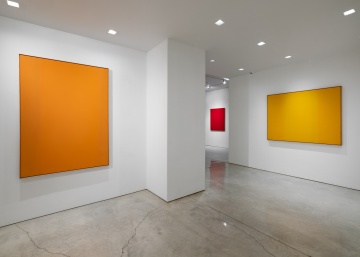
One of the most important and innovative painters of his generation, Joseph Marioni (1943–2024) developed his groundbreaking, sensuous, and sensitive work over a more than fifty-year career.
To look at a painting by Joseph Marioni is to engage with what he called a “portrait of color”: each painting’s size, shape, and particular application of paint (Marioni used a paint roller, with which he controlled the paint’s fluid cascade down the surface of the linen support) are calibrated to present a single color from multiple, differently hued painted layers. The final product is what Marioni called “liquid light,” his term conveying the exquisite tension between the liquid bodies of his paintings and the weightless light they emanate to the viewer.
Beginning with subtle experiments in line and color in 1970, Marioni’s practice evolved in the years that followed into a profound investigation of painting’s most fundamental properties: paint, color, materiality, and light. This presentation, the first in New York since 2006, focuses on the second half of Marioni’s career, during which his painting most profoundly synthesized the fluid materiality of his painted surfaces with the immateriality of light and color. Marioni moved to New York in 1972 and was a leading member of the Radical Painting Group during the ‘70s and ‘80s along with artists such as Marcia Hafif, Olivier Mosset, and Günter Umberg. Marioni also maintained dialogues with Clyfford Still, Brice Marden, and Robert Ryman.
Light was the very heart of Marioni’s project, as well as the whole history of painting as he saw it. As he put it: “What is miraculous about the art of painting is its unique emotional engagement with light. Light is at the very core of its being… So when the sun of the day visits the body of the painting on the threshold of the wall, the painting is pregnant with light and we are witness to the life in its being. Its subject is the gravity of its light.”
Larry Poons
Provocation, Iliad: Powers + Spells
April 5, 2025 - August 15, 2025
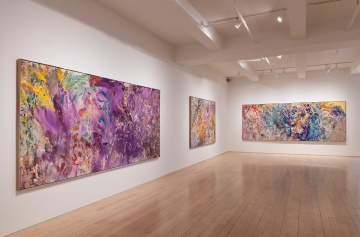
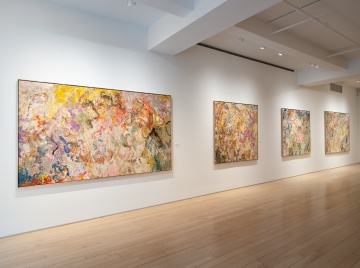
YARES ART is pleased to present LARRY POONS: Provocation, Iliad: Powers + Spells, an exhibition of seventeen major works curated by the esteemed critic and art historian, Karen Wilken. At 87, the legendary artist continues to capture his creative powers, as evidenced by the large-scale canvases on view here—all from 2024—which present the audience with unequaled expanses of resonating color and luminosity.
At this juncture in his long career, Poons engages with his own kind of mythmaking, having been inspired in part by Homer’s Iliad. Titles of certain works, such as Tell Me Muses (Powers + Spells #2), Achilles, and Zeus, directly allude to the epic poem, while expansive compositions like Briseis Bright + Bashful, Hat of the Owl, and Fear have an imposing quality that visually parallels the heroic scope of the ancient Greek literary monument. Neither Impressionist nor Expressionist, yet embracing attributes of both genres, Poons conjures a dynamic battleground.
Yet, the layered underpaintings of translucent color he employs are more subtle and emotive than ever before, unlike previous work in which Poons’s compositions display an allover approach, often with several dominant hues. At times, this new series of paintings evoke elements of figuration and landscapes exploding with flora and fauna.
The Color Field pioneer further activates the ethereal spaces with intense clusters of sinuous markings using narrow brushes as well as his hands and fingers. Briseis Bright + Bashful emanates a warm, radiant glow befitting the Homeric princess named in the title. At the upper right corner of the canvas, airy washes of pale pastel colors suggest distant horizons. In the panoramic, horizontal expanse of Fear, one of the largest works on view (nearly 51⁄2 by 16 feet), feverish markings and undulating fields of color shift in tonality from earthy hues on the left to brilliant celestial and aquamarine blues on the right.
His works offer purely sumptuous visual sensation, but not without conflict. In his inimitable visual language, refined over the course of nearly seventy years, he explores the schism between the forces of tumultuous change and immutable, timeless permanence that is the hallmark of great works of art.
Born in Tokyo in 1937 to Anglo-American parents, Poons relocated with his family to the United States at a young age and studied music composition at the New England Conservatory of Music in Boston. Recognizing his greater talent for visual art, he transferred to the School of the Museum of Fine Arts, Boston, where he studied painting. He achieved significant success as a visual artist soon after he moved to New York in the early 1960s. Larry Poons’s work is included in many prominent public and private art collections throughout the world, including the Art Institute of Chicago; the Buffalo AKG Art Museum; the Centre Pompidou, Paris; the Cleveland Museum of Art; the Hirshhorn Museum and Sculpture Garden and the Smithsonian American Art Museum, Washington, D.C.; the Metropolitan Museum of Art, the Museum of Modern Art, and the Whitney Museum of American Art, New York; the Museum of Contemporary Art, Los Angeles; the Museum of Fine Arts, Boston; the Museum of Fine Arts, Houston; the Philadelphia Museum of Art; the Santa Barbara Museum of Art; the Tate Modern, London; the Van Abbe museum, Eindhoven, Netherlands; and the Yale University Art Gallery, New Haven, among numerous other institutions.